Downsize Your Drive, Not Your Power: The A3V Pump Changes the Sustainability Equation

For years, the path to sustainability in industrial hydraulics seemed to involve trade-offs. Gaining energy efficiency often meant complex system designs or accepting limitations. But what if you could achieve massive energy savings while also reducing investment costs, simplifying your machine build, and improving performance?

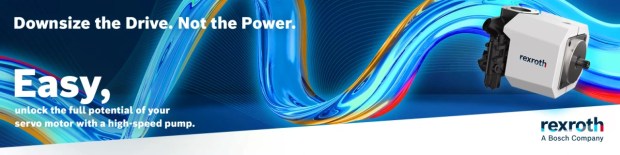
This is the new reality made possible by the Bosch Rexroth A3V pump platform, a highly efficient, high-speed variable displacement pump designed specifically for modern, speed-controlled industrial applications.

The Speed-to-Torque Revolution

The fundamental principle behind the A3V is a game-changer for machine design. In a speed-variable pump system, the required motor torque is directly related to the pump’s displacement and speed. By designing the A3V to operate reliably at exceptionally high speeds—up to 4000 rpm—we’ve flipped the traditional design equation.

This higher speed allows the pump to achieve the same flow rate with a smaller displacement, which in turn reduces the required motor torque by up to 30%.

What does this mean for you?

  • Downsize Your Motor: You can now use a smaller, less expensive servo motor.
  • Reduce Drive Costs: A smaller motor often allows for a smaller, more cost-effective converter.
  • Eliminate Liquid Cooling: In many cases, the smaller servo motor can be air-cooled, eliminating the cost and complexity of water-cooling circuits.

The result is a direct reduction in both initial investment cost and long-term operating costs.

Efficiency You Can Measure (And Hear)

The A3V platform isn’t just fast; it’s a new benchmark for efficiency in medium-pressure hydraulics. With a total efficiency of up to 93%—five percentage points higher than previous generations—it minimizes energy losses during operation. For cyclic applications like injection molding or presses, this can translate to overall energy savings of up to 80% compared to constant-speed systems.

We also engineered the A3V for quieter operation. Its design significantly reduces pressure pulsation, a primary source of hydraulic noise. This leads to a quieter machine, a more comfortable working environment, and less vibrational stress on the entire system.

Built for the Future of Hydraulic Drives

The A3V platform is purpose-built for the demands of modern electro-hydraulic systems.

  • Recuperation Ready: In applications like lowering a lifting platform or counter-holding a die cushion, the A3V can act as a motor, driving the servo motor as a generator to feed power back into the grid or intermediate circuit.
  • Unlimited Start/Stop: Designed for highly cyclic applications, it has no restrictions on start/stop cycles or prolonged pressure holding.
  • Dynamic and Variable: The combination of variable displacement and variable speed allows the system to achieve any operating state with optimized energy use, from high-flow movements to high-pressure holding with minimal torque.

The Smart Choice for Sustainable Hydraulics

The A3V pump platform proves that sustainability and cost-efficiency can go hand-in-hand. By enabling the downsizing of core drive components while delivering best-in-class performance, it represents the next generation of intelligent, medium-pressure industrial hydraulics.

Ready to rethink your drive train? Contact your CMAFH representative to see how the A3V can power your next machine.

CMA/Flodyne/Hydradyne is an authorized Bosch Rexroth distributor in Illinois, Wisconsin, Iowa and Northern Indiana.

In addition to distribution, we design and fabricate complete engineered systems, including hydraulic power units, electrical control panels, pneumatic panels & aluminum framing. Our advanced components and system solutions are found in a wide variety of industrial applications such as wind energy, solar energy, process control and more.
Pair, Tune, Perform: Your Hydraulics, Now on Bluetooth

Hydraulics just got a modern user interface: Easy2Connect App

Bosch Rexroth’s Bluetooth-enabled valve solution brings commissioning, tuning, and diagnostics to your iPhone or iPad through the new Easy2Connect app, now live in the US Apple App Store. What used to require a laptop, a cable, and a pile of guesswork is now a quick pairing and a clear dashboard.

Here’s how it works: add the compact Bluetooth dongle (R901505294, VT-ZBT-1-1X) to your valve, open Easy2Connect, and you’re in. You can see configuration at a glance, adjust dynamics with guided steps, and capture error messages in seconds. Whether you’re bringing a line online or chasing down a stubborn issue, you get actionable data where it matters—right at the machine.

It’s time to pair up your valves and get commissioning down to a science.

If you’re running valves like 4WRAE6-3XDBETA-7XDBETE-7X3DREA6, or Z3DREA6, (Data Sheets Link) this is a simple upgrade that makes a noticeable difference.

Many users already have the valves on-site; adding the Bluetooth “black box” unlocks the digital layer that speeds commissioning, lifts productivity, and maximizes availability. And because it’s retrofit-friendly, you can standardize the experience across mixed fleets without a major overhaul.

The launch starts with iOS in the US, with Android submission to the Google Play Store coming next. Europe and China will continue to run their regional app versions. If you’ve been waiting for the US release, your wait is over, download Easy2Connect, order the dongle if you don’t already have it, and turn your hydraulics into a connected, intuitive system.

CMA/Flodyne/Hydradyne is an authorized Bosch Rexroth distributor in Illinois, Wisconsin, Iowa and Northern Indiana.

In addition to distribution, we design and fabricate complete engineered systems, including hydraulic power units, electrical control panels, pneumatic panels & aluminum framing. Our advanced components and system solutions are found in a wide variety of industrial applications such as wind energy, solar energy, process control and more.

Why Machine Tool Builders Are Rethinking Hydraulic Power Units

Bosch Rexroth Web Editorial TeamEditor

When every square inch of factory floor space costs money, why are machine tools still using bulky hydraulic power units that waste half their footprint?

The Installation Space Problem

Machine tool manufacturers face a constant challenge: customers want more capability in less space. As workpieces get smaller and precision requirements increase, every component needs to justify the room it occupies.

Traditional hydraulic power units haven’t kept pace with this miniaturization trend. A standard 4 kW unit typically requires 100 liters of oil capacity, a separate control cabinet, external cooling circuits, and enough clearance for maintenance access. That’s a lot of real estate for what’s essentially a support system.

Four Innovations That Changed Everything

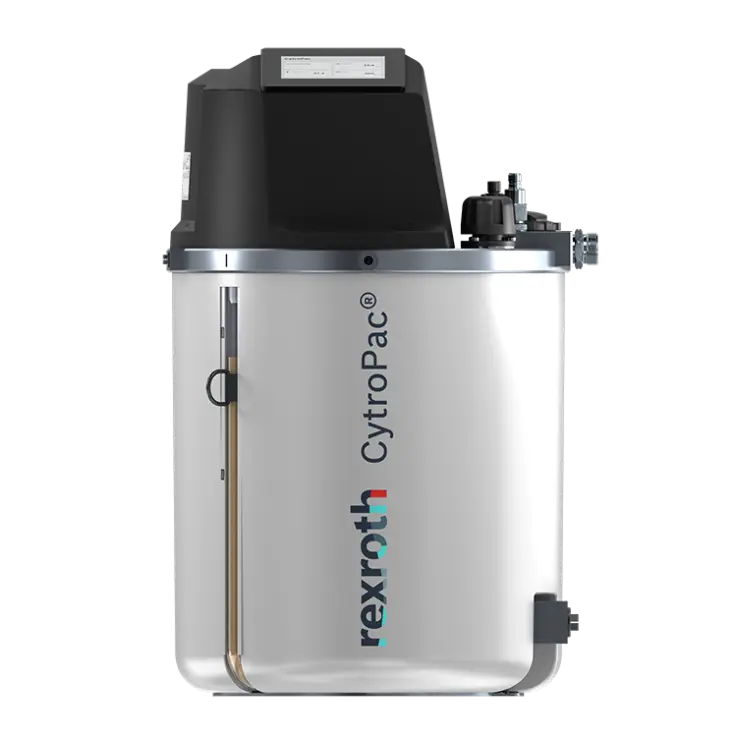
Bosch Rexroth’s CytroPac takes a completely different approach—one that eliminates the traditional “installation space eaters” through intelligent integration:

1. Optimized Tank Design
By rethinking how oil degasses, engineers reduced tank volume by 80%—from 100 liters down to just 20 liters. That’s the same hydraulic performance in half the space.

2. Integrated Frequency Converter
The fully-wired frequency converter with multi-Ethernet interface lives inside the power unit itself. No separate control cabinet required. For many installations, that eliminates cabinet space entirely.

3. Heatpipe Cooling Technology
Instead of bulky cooling circuits, passive heatpipes transfer thermal energy from the motor, converter, and oil to a central cooling water connection. This cuts another layer of complexity and space consumption.

4. Built-in Condition Monitoring
Integrated sensors monitor fill level, temperature, pressure, and filter contamination—feeding data directly to Industry 4.0 systems through standard interfaces like Ethernet-IP, EtherCAT, and Profinet.

The Quiet Revolution: Noise Reduction Benefits

Manufacturing environments face increasing pressure to reduce workplace noise levels—both for operator comfort and regulatory compliance. Traditional hydraulic power units contribute significantly to ambient noise through pump operation, cooling fans, and pressure fluctuations during load changes.

CytroPac addresses this through multiple integrated design features. The variable-speed drive eliminates the constant high-RPM operation that characterizes fixed-speed systems—the pump only runs as fast as needed for current demand. Combined with optimized tank design that reduces fluid turbulence and heatpipe cooling that eliminates noisy cooling fans, overall sound emissions drop noticeably. Machine tool builders report quieter operation that improves the working environment without requiring additional sound insulation or enclosures.

Energy Efficiency That Pays Back

Energy costs represent a growing portion of manufacturing overhead, making hydraulic system efficiency more than an environmental consideration—it’s an economic one. Traditional fixed-speed hydraulic systems run at full capacity regardless of actual demand, wasting energy during idle periods and low-load operations.

CytroPac’s integrated frequency converter fundamentally changes this equation. The variable-speed drive adjusts pump speed continuously to match hydraulic demand, consuming energy proportional to actual work performed. This approach complies with EU Eco-Design Directive 2009/125/EC while delivering measurable cost savings. In typical machine tool duty cycles with significant idle time between operations, energy consumption can drop 30-50% compared to conventional fixed-speed units. For manufacturers running multiple machines across shifts, those savings compound quickly—turning energy efficiency from a compliance requirement into a competitive advantage.

Why Machine Tool Builders Are Rethinking Hydraulic Power Units

What This Means in Practice

The total footprint reduction? Up to 50% compared to conventional designs of equivalent performance.

But space savings aren’t the only benefit. Machine builders also gain:

  • Faster installation: Connect power, cooling water, data interface, and hydraulic supply—done
  • Reduced assembly errors: Everything’s pre-wired and tested at the factory
  • Lower total cost: Smaller footprint means smaller machine frame or larger work envelope
  • Future-ready connectivity: Condition monitoring enables predictive maintenance strategies

The Control Cabinet Question

Here’s where integration really pays off. When the frequency converter, sensor technology, and motor are all pre-wired within the power unit, many machine designs can eliminate the hydraulic control cabinet completely.

Even when cabinet space remains necessary for other systems, reducing its footprint by 100% for the hydraulic portion creates flexibility for other components or simply reduces the overall machine size.

A Different Design Philosophy

CytroPac represents a fundamental rethinking of what a hydraulic power unit should be. Rather than optimizing individual components and assembling them, the approach integrates everything from the start—designing for the complete system performance in minimum space.

This matters because machine tool economics increasingly favor compact, flexible designs. When manufacturers can offer the same machining capability in a smaller footprint, they win business. When they can integrate hydraulics without sacrificing valuable working space, they differentiate their products.

Beyond Just Smaller

Miniaturization alone wouldn’t justify redesigning a proven technology. But when you combine space savings with energy efficiency (variable-speed drives only consume what’s needed), simplified installation (plug-and-play connectivity), and Industry 4.0 readiness (integrated condition monitoring), the value proposition becomes compelling.

Machine tool builders working in the 4 kW performance range now have an alternative to the “bigger tank, bigger cabinet, bigger footprint” tradition.

Want to see how much space CytroPac could save in your next machine design? Bosch Rexroth application engineers can evaluate your specific requirements and demonstrate the integration advantages.

CMA/Flodyne/Hydradyne is an authorized Bosch Rexroth distributor in Illinois, Wisconsin, Iowa and Northern Indiana.

In addition to distribution, we design and fabricate complete engineered systems, including hydraulic power units, electrical control panels, pneumatic panels & aluminum framing. Our advanced components and system solutions are found in a wide variety of industrial applications such as wind energy, solar energy, process control and more.
Safety Solved: How STO Manifolds Deliver Critical Machine Protection Without the Engineering Headaches

Bosch Rexroth Web Editorial

When hydraulic system failures mean production stops, product gets damaged, or worse—people get hurt—you need more than components. You need solutions that work right out of the box.

Your Safety Challenge Just Got Simpler

Machine builders and plant operators face a persistent problem: meeting ISO 13849 functional safety requirements for hydraulic systems often means months of engineering, custom manifold design, complex safety assessments, and expensive validation. One miscalculation, and you’re back to square one.

The Bosch Rexroth STO (Safe Torque Off) Manifold eliminates this complexity entirely.

Problem Solved: Safety Functions That Work From Day One

The STOM series delivers pre-engineered, pre-validated safety shutdowns for hydraulic systems up to Category 4 PLe—the highest safety level defined by ISO 13849. Instead of designing your own safety circuits, you select from three standardized configurations based on four simple parameters:

  • Pressure (up to 315 bar)
  • Flow rate (up to 1750 l/min)
  • Required safety level (Cat 3 or Cat 4)
  • Functions needed (STO, SDE, SLS)

Your hydraulic problems—solved. From design constraints to uptime issues, we identify root causes and deliver effective hydraulic solutions.

Three Safety Functions in One Compact Block

Safe Torque Off (STO): Two-channel, position-monitored blocking from P1 to P2 ensures leak-free shutdown of entire machine areas or systems. When it must work—you call us.

Safe Decompression (SDE): Controlled pressure relief through dual bypass valves with flow-limiting nozzles safely drains downstream pressure in under 300ms in most applications. No sudden movements. No unexpected energy release.

Safe Limited Speed (SLS): Pre-compression through the same bypass circuit minimizes switching shocks, extends component life, and reduces noise—while meeting functional safety requirements for controlled flow.

The Engineering Time You’ll Save

Traditional custom safety manifolds require:

  • 40-80 hours of safety circuit design
  • Risk assessment documentation
  • Component selection and validation
  • Safety logic programming
  • Final system validation

With STOM, you select a material number from a datasheet. Documentation, validation calculations, and installation instructions are included. Every solution is engineered to simplify your machine lifecycle: Design → Installation → Operation → Maintenance.

Real-World Reliability From Decades of Expertise

The STOM portfolio builds on proven Bosch Rexroth valve technology—pilot-operated check valves (SL) in sizes 20/30, and actively controllable 2-way cartridge valves (LC2A) in sizes 32/40. These aren’t experimental components. They’re field-tested workhorses now configured for functional safety.

Galvanized surface coating provides long-term corrosion protection. Compatibility with mineral oils (HLP) and flame-resistant fluids (HFC, HFDU) means retrofit flexibility. Identical electrical control across all nominal sizes simplifies commissioning and spare parts management.

Stop Paying an Electrician to Wire Your Hydraulic Valves

Bosch Rexroth STO (Safe Torque Off) Manifold 

When Performance Bottlenecks Impact Output

Heavy-duty presses, metallurgical plants, and test benches face a common challenge: hydraulic area shutdowns that meet safety standards while minimizing production disruption.

A metal forming facility recently integrated STOM-32B4E manifolds for zone isolation. Results:

  • 87% reduction in safety engineering time versus custom design
  • Closing times under 280ms with 200-bar system pressure
  • Safe decompression in 1.2 seconds for 12-liter downstream volume
  • Zero safety-related downtime in first 18 months of operation

When performance bottlenecks impact your output, our specialists solve them with data-driven, high-performance hydraulics.

Your Challenges Just Became Manageable

Whether you face unpredictable downtimes during retrofits, need breakthrough safety compliance for new machine designs, or require reliable area shutdown for high-risk operations—STOM manifolds make your challenges manageable.

We’re not just a hydraulics supplier. We are the problem solvers behind your productivity—reducing downtime, simplifying design, streamlining installation, and optimizing performance.

CMA/Flodyne/Hydradyne is an authorized Bosch Rexroth distributor in Illinois, Wisconsin, Iowa and Northern Indiana.

In addition to distribution, we design and fabricate complete engineered systems, including hydraulic power units, electrical control panels, pneumatic panels & aluminum framing. Our advanced components and system solutions are found in a wide variety of industrial applications such as wind energy, solar energy, process control and more.
How Rittal’s RiLineX Busbar System Transforms Data Centres

Data centres are the beating heart of our digital world. Keeping them running efficiently and safely is a monumental task. As the need for processing power and data storage increases, the complexity of power distribution systems also grows. 

Traditional, cable-heavy solutions are becoming cumbersome, inflexible, and a potential point of failure. This is where modern busbar systems, specifically Rittal’s RiLineX, are revolutionising the game.

But what exactly is this system, and why should data centre operators be paying attention?

What is the Rittal RiLineX Busbar System?

Think of the RiLineX system as a modular power “highway” for your data centre racks. Gone are the days of running multiple bulky cables from the PDU to each server. The RiLineX system uses a compact touch-safe busbar.

This busbar provides a centralised and standardised track for power. You can easily and safely “plug” connection adapters and circuit breakers onto the busbar wherever you need power. This simple plug-and-play method replaces the messy “spaghetti” of old wiring. We offer a safe, flexible, and easy-to-use option.

RiLineX

Key Benefits of RiLineX in Data Centres

1. Enhanced Safety

Safety is paramount in any high-voltage environment. The RiLineX busbar is fully encapsulated and touch-safe (IP2XB). This safety feature dramatically reduces the risk of accidental contact and electrical shock.

This design minimises the potential for human error during installation or maintenance, creating a safer working environment for technicians. Standardised connections provide secure, reliable contacts and reduce the risk of faults from loose terminations. This is also easily upgradable to IP3X should the end client require it.

2. Superior Flexibility and Scalability

Data centres are not static; they are constantly evolving. The biggest advantage of the RiLineX system is its incredible modularity. Whether you’re adding a new server rack or reconfiguring an existing one, the process is straightforward.

Instead of lengthy recabling, simply add a new connection adapter to the busbar in minutes. This “pay-as-you-grow” model allows for seamless scalability. RiLineX helps to ensure your power infrastructure can keep up with your operational demands, without downtime or costly overhauls.

3. Space Optimisation

In a data centre, every square inch of rack space is valuable real estate. Traditional cabling occupies valuable space that would be better used for IT equipment.

The RiLineX system is exceptionally compact. It runs vertically in the rack, occupying minimal space and leaving more room for servers, storage, and networking gear. This efficient use of space helps maximise the density and profitability of the data centre.

4. Faster Installation and Maintenance

Time is money, especially in a data centre where downtime can have catastrophic financial consequences. The plug-and-play nature of the RiLineX system makes installation a breeze. The components mount without tools, reducing setup time and labour.

This speed and simplicity also extend to maintenance. Swapping out a faulty component or adding a new circuit is a quick and straightforward task. Having minimising mean time to repair (MTTR) helps with keeping your critical systems online.fri250408700

The Smart Choice for Modern Power Distribution

As data centres become more powerful and dense, the limitations of traditional cabling methods become increasingly apparent. Rittal’s RiLineX busbar system offers a compelling solution that directly addresses the core challenges of safety, scalability, and efficiency.

RiLineX offers a safer, more flexible, and space-efficient power distribution system. By enabling data centre managers to build future-ready infrastructures, RiLineX becomes more than just a cabling alternative. Embrace our new busbar system as a strategic investment for your data centre.

CMA/Flodyne/Hydradyne is an authorized  Rittal distributor in Illinois, Wisconsin, Iowa and Northern Indiana.

In addition to distribution, we design and fabricate complete engineered systems, including hydraulic power units, electrical control panels, pneumatic panels & aluminum framing. Our advanced components and system solutions are found in a wide variety of industrial applications such as wind energy, solar energy, process control and more.
Why Panel Shops Are Moving to Automated Busbar Panel Modification

Overview

  • As panel shops move from traditional cabling to busbar, they are faced with an important decision: manual busbar modification or automated busbar modification?
  • Panel shops that choose automated busbar modification are faced with an additional decision: outsourced or in-house?
  • Automated busbar modification is faster, less error-prone, more precise, less wasteful, and offers a variety of other benefits.
  • Rittal Automation Systems machinery for busbar modification is helping panel shops to bring automated modification in-house so they can reap these benefits.

The move away from traditional cabling and toward busbar continues, and many panel shops I’ve talked to lately are facing challenges with keeping up with demand. Their customers increasingly want copper busbar, and it’s no surprise. For high-amperage systems, such as those above 1000A, they can’t use cables because they’ll melt. Copper is a great conductor of electricity that handles heat well and helps suppliers in fields like energy & power meet safety standards like UL 891.

In addition to greater demand for busbar from the energy & power sector, panel shops are seeing increasing demand from data centers, where busbar is prized because of its space-saving efficiency, flexibility, and reliability. IT applications are only expected to grow with the advancement of AI, with its massive computing and data storage needs.

Rittal is helping panel shops all over the U.S. make the transition to busbar and capitalize on this demand. From mom-and-pop shops to huge operations, I work with Rittal customers to provide a range of busbar solutions. Sometimes this involves completing busbar modification jobs for customers at the Rittal Application Center (RAC) in Houston, Texas. Lately, though, I’ve had several customers invest in automated busbar modification machinery of their own. Here’s why.

Manual vs. automated busbar modification options

The panel shops I work with are usually producing modified busbar in one of two ways: they are manually modifying it themselves using hand tools or they are outsourcing modification to a facility like the RAC.

Shops are incentivized to move from manual modification to automated modification when they realize that automated modification is:

  • Faster: What might take an operator 15 minutes takes machinery 30 seconds.
  • Less error-prone: Humans make mistakes, but mistakes with busbar are expensive because the price of copper is very high.
  • More precise: Machinery can more easily achieve the strict tolerances required for busbar modification.
  • Less wasteful: Because they are more precise and make fewer mistakes, machines produce less scrap — again important due to the high price of copper.
  • Less reliant on individual operators’ expertise: Manual modification means shops come to depend on specific operators, and operator departures can create problematic knowledge gaps. In a world where shops are competing for skilled labor, automation can help create a centralized knowledge base.

Automated modification is the obvious winner, but outsourcing busbar modification has its pros and cons. The RAC does a fantastic job producing custom modified busbar in as little as a few days, and Rittal provides a turnkey solution that allows customers to buy cabinets and busbar together. There are cases, however, where it is more cost-efficient for growing panel shops or those with very large orders to invest in in-house automation equipment. Plus, with their own machines, shops are able to better control busbar modification lead times — a big pro for many of the shops I work with.

CMA/Flodyne/Hydradyne is an authorized  Rittal distributor in Illinois, Wisconsin, Iowa and Northern Indiana.

In addition to distribution, we design and fabricate complete engineered systems, including hydraulic power units, electrical control panels, pneumatic panels & aluminum framing. Our advanced components and system solutions are found in a wide variety of industrial applications such as wind energy, solar energy, process control and more.
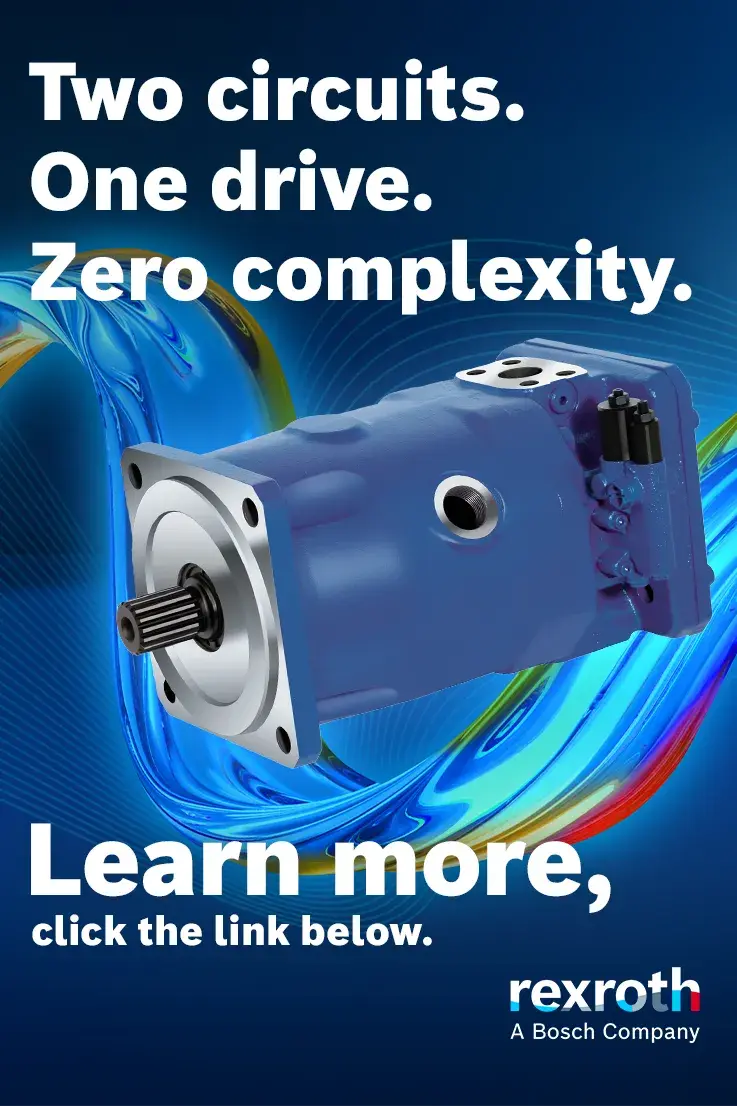
New VX Hybrid Double Door Enclosure Simplifies Configuration and Installation

OVERVIEW

  • Rittal’s new VX Hybrid Double Door enclosure is a single-solution industrial enclosure that combines simplicity and durability
  • NEMA 4 and NEMA 4x protection options make the VX Hybrid Double Door enclosure a versatile solution for a variety of industrial applications
  • The VX Hybrid Double Door enclosure offers maximum rigidity without additional weight to optimize protection without sacrificing mobility
  • The VX Hybrid Double Door enclosure is manufactured at Rittal’s Urbana, Ohio facility to help reduce delivery times

One of the biggest benefits with modular enclosures is how they simplify and accelerate configuration and installation in service of helping companies reduce lead times and navigate labor shortages. Plus, the modular design of such enclosures helps reduce your bill of materials (BOM) and makes it easier to maintain enclosures in the field.

However, it can be a challenge finding a modular enclosure that marries this level of flexibility with the required durability and rigidity necessary for deployment in more intense or extreme industrial applications. This kind of enhanced protection was usually reserved for unibody enclosures, but Rittal’s new VX Hybrid Double Door enclosure changes the game, providing exceptional durability and rigidity without complicating the configuration and installation process.

There are a couple of key design features that make this double door industrial enclosure a unique option in today’s market. Here are a couple of ways in which the new VX Hybrid Double Door enclosure combines simplicity, protection, and performance.

Modular design with NEMA 4 and NEMA 4x protection

The industrial space has always been one of challenging or harsh operating conditions, requiring industrial enclosures that can combat a variety of environmental hazards. But the evolution of the industrial space — and manufacturing in particular — to include more outdoor and 24/7 production parameters increases the need for industrial enclosures with higher NEMA ratings.

CMA/Flodyne/Hydradyne is an authorized  Rittal distributor in Illinois, Wisconsin, Iowa and Northern Indiana.

In addition to distribution, we design and fabricate complete engineered systems, including hydraulic power units, electrical control panels, pneumatic panels & aluminum framing. Our advanced components and system solutions are found in a wide variety of industrial applications such as wind energy, solar energy, process control and more.

Kassow Robots Introduces Sensitive Arm Technology for Enhanced Collaborative Robotics

The Sensitive Arm system provides real-time, low-latency force feedback while utilizing integrated torque sensors across all joints.

Kassow Robots , a leading manufacturer of 7-axis collaborative robots, announced its Sensitive Arm technology across its complete range of 7-axis collaborative robots. Introduced at Automate 2025 in Detroit, MI, this advanced force control system integrates high-resolution torque sensors into all seven joints of each robot, enabling manufacturers to automate delicate and contact-sensitive tasks with greater precision, safety and flexibility.

The Sensitive Arm system provides real-time, low-latency force feedback while utilizing integrated torque sensors across all joints. With a sensor resolution of up to 0.024 Nm/bit and a control frequency of 30 kHz, the system enables compliant and nuanced motions essential for complex tasks such as assembly, surface finishing, inspection and delicate handling.

“The Sensitive Arm is transforming how manufacturers approach automation of complex assembly and finishing operations,” said Dieter Pletscher, global sales manager at Kassow Robots. “Our customers are seeing immediate benefits in applications requiring controlled contact forces from precision assembly to surface finishing while maintaining the industrial strength and flexibility that Kassow Robots’ 7-axis design is known for.”

Operators can fine-tune how the robot responds to external forces using a dedicated interface that makes it easy to adjust parameters such as stiffness, damping and end-effector compliance. The system also enables one of the smoothest and most responsive hand-guiding experiences on the market, with minimal resistance and high sensitivity, enabling fast and intuitive programming by demonstration. This significantly reduces the time and complexity involved in deploying new applications.

By eliminating the need for external force and torque sensors, the Sensitive Arm simplifies system integration while improving feedback accuracy. It also improves collaborative safety by enabling faster, more reliable detection of impacts or unexpected contact, creating safer conditions for human-robot interaction on the factory floor.

The Sensitive Arm is available across Kassow Robots’ entire 7-axis collaborative robot portfolio, including new high-payload models, expanding automation possibilities for complex and sensitive tasks. Kassow Robots‘ expanded lineup now offers significantly greater payload capacities while maintaining precision and safety.

To learn how Kassow Robots is advancing collaborative robotics with the Sensitive Arm, please visit https://www.kassowrobots.com/.

CMA/Flodyne/Hydradyne is an authorized Kassow Robots distributor in Illinois, Wisconsin, Iowa and Northern Indiana.

In addition to distribution, we design and fabricate complete engineered systems, including hydraulic power units, electrical control panels, pneumatic panels & aluminum framing. Our advanced components and system solutions are found in a wide variety of industrial applications such as wind energy, solar energy, process control and more.

Flexibility with Kassow Robotic Welding Scales up Production

Bountourakis is a Greek manufacturing company specializing in HORECA equipment, supplying Inox stainless steel kitchen units, showcases, and tables—particularly well-known across Heraklion on Crete. To scale up its welding operations, the company turned to Kassow Robots’ partner Netelco S.A. Together, they implemented the KR1805 cobot, enabling flexible welding with both Laser and TIG technologies.

Challenge

A shortage of skilled welders was limiting Bountourakis’ ability to meet growing production demands. “Like a lot of businesses, we find it really hard to find someone who can weld and who can sometimes be flexible with their hours during busy times. As our production is on the island, it makes it even harder,” says Adonis Bountourakis, Head of Production of Bountourakis.

Despite having invested in a laser welder, the company lacked enough staff to operate it, causing significant delays—especially for small parts, which could take days to complete. The goal was to make welding easier, faster, and more scalable.

Solution

Netelco S.A delivered a custom robotic welding cell, equipped with a gripper changer that allows the robot to switch between laser and TIG welding tools. The laser welder, provided by the customer, was successfully integrated into the setup by Netelco S.A. “We had an initial meeting, then the customer sent us the laser welder and asked us to do some welding with the robot. We showed him how it works. He was really happy with it and decided to go for Kassow Robots. It was a really smooth process”, says Anastasios Paraskevopoulos, sales rep at Netelco S.A.

Thanks to the KR1805’s long reach and 7th axis, the robot is now capable of welding a wide variety of parts such as refrigerators, cooking appliances, ovens and washing /hygiene units—and ready to handle more complex tasks in the future.

Benefits

Bountourakis highlights the ease of use, flexibility, and robustness of the KR1805 cobot. The company has significantly increased its welding throughput while reducing dependence on manual labor—scaling production and staying competitive in a demanding market.

Curious to see how others are automating welding with Kassow Robots? Check out another use case where a flexible cobot setup made all the difference.

CMA/Flodyne/Hydradyne is an authorized Kassow Robots distributor in Illinois, Wisconsin, Iowa and Northern Indiana.

In addition to distribution, we design and fabricate complete engineered systems, including hydraulic power units, electrical control panels, pneumatic panels & aluminum framing. Our advanced components and system solutions are found in a wide variety of industrial applications such as wind energy, solar energy, process control and more.
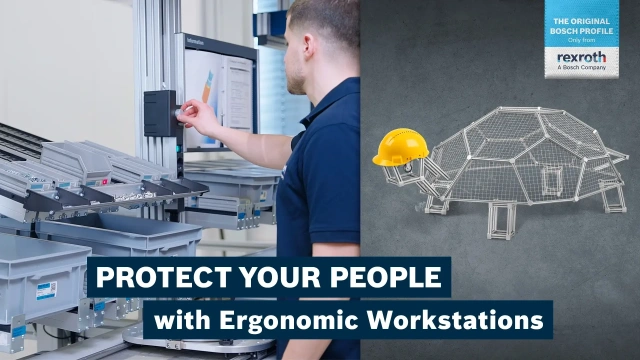
Two functions, one component

The new standard gripper from the Zimmer Group has got it right

Laboratories are currently facing increasing pressure to automate: the number of samples is growing, traceability is being monitored more strictly, and cycle times are getting shorter—all while maintaining the highest level of precision. Manual steps such as screwing sample tubes open and closed, precisely aligning barcodes, or labeling vials can become bottlenecks if they are not reliably automated. Conventional grippers quickly reach their functional and design limits here.

With the new 2-jaw parallel rotary gripper of the REP2000 series, the Zimmer Group presents a component that combines gripping and turning in a single component – a well-thought-out answer to the high demands of modern laboratory automation.

Maximum functionality in a minimum of space: The compact combination of gripping and turning unit saves valuable installation space in cramped machine layouts. This is a decisive advantage when system modules need to be retrofitted or modernized. Instead of two separate modules, only one drive needs to be controlled. This reduces the amount of wiring, simplifies installation, and, last but not least, saves investment and operating costs.

Flexibility as standard: IO-Link as the key

Control via IO-Link takes the REP2000 to a new level. Users can vary the stroke of the gripping jaws to suit different vial and container diameters. At the same time, the swivel angle of the continuously rotatable unit can be precisely adjusted to the process. This means that a wide variety of container types can be opened, closed, or precisely positioned automatically without the need for mechanical modifications or long downtimes.

This flexibility is a decisive advantage for maximizing system availability, especially in laboratories where product changes or different sample batches are frequently processed.

Process reliability is also ensured in emergencies: Sample material is precious – any loss means time and money. This makes the mechanical self-locking mechanism of the REP2000 all the more important: in the event of a power failure, it holds the workpiece securely in place. An integrated emergency release allows the gripper to be opened manually so that samples can be removed quickly and safely – a safety feature that makes all the difference in an emergency.

With up to five million maintenance-free cycles, the REP2000 proves that high cycle counts and compact design are not mutually exclusive. Thanks to integrated position sensing, every stroke is monitored – this increases process quality and facilitates preventive maintenance. The REP2000 also has IP54 protection.

Specific application: faster sample throughput

The flexibility is evident in practice: in an automated sample preparation line, the REP2000 can take over the automated opening and closing of sample tubes. At the same time, it aligns the vessels precisely so that barcodes can be reliably detected. Two work steps, one component – the time savings are measurable and the process is more stable.

Conclusion: Compact solution for complex tasks

The REP2000 provides system integrators and laboratory operators with a cost-effective solution for typical automation challenges in the laboratory: less installation space, fewer components, less downtime – with maximum process reliability. For anyone who wants to make their systems fit for increasing sample numbers and flexible processing, the 2-jaw parallel rotary gripper from the REP2000 series is the next logical step.

CMA/Flodyne/Hydradyne is an authorized  Zimmer Group distributor in Illinois, Wisconsin, Iowa and Northern Indiana.

In addition to distribution, we design and fabricate complete engineered systems, including hydraulic power units, electrical control panels, pneumatic panels & aluminum framing. Our advanced components and system solutions are found in a wide variety of industrial applications such as wind energy, solar energy, process control and more.